As Philo-The-Third told me, his father – Philo T. Farnsworth The Second – had ‘two major cases in his life.
The first was electronic video. You wouldn’t be looking at this if he hadn’t cracked that one back in the 1920s.
Over the course of the next thirty-plus years, Farnsworth gained as much first-hand knowledge about the practical workings of the quantum realm as anybody who worked at Los Alamos. In fact, he was invited to participate in The Manhattan Project, but declined the invitation, telling his wife “I want nothing to do with building an atomic bomb.”
Instead, in the 1950s and 60s, he used his experience and singular insight to conceive and build something not even the assembled wizards at Los Alamos could fathom: a controlled nuclear fusion device, a ‘start in a jar.
This second preview from The Boy Who Invented Television recounts the moment he figured it out:
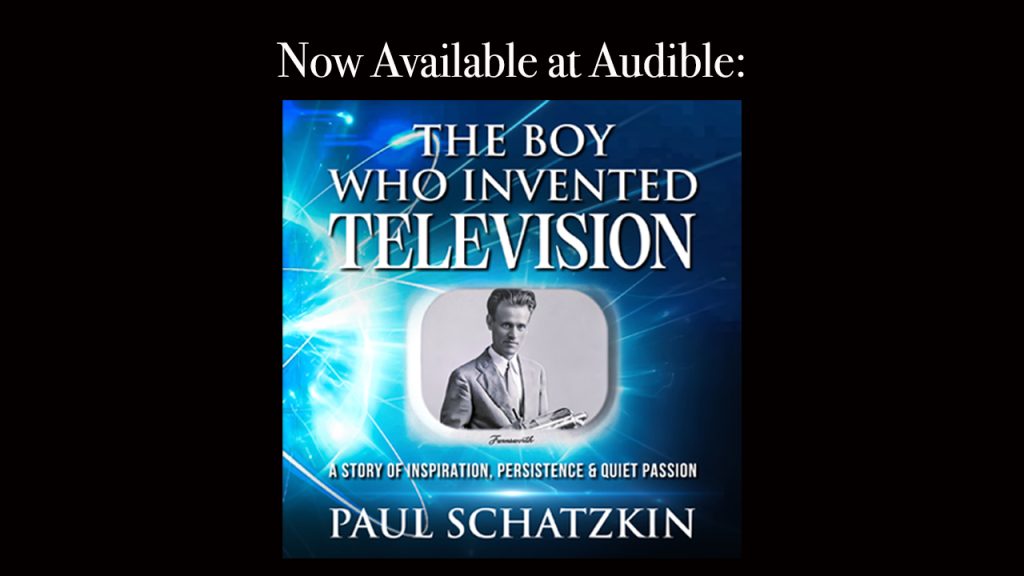
The audiobook edition is now available on Amazon or Audible.
Y’all get yer ears on!
Just finished reading the book. Well done. I’m going to see if it can have some therapeutic value for one of my teen nephews (just ordered one for him.) He has joined the ranks of millions of youths that are addicted to video and phones. The phone never leaves his hand. I say addicted because like all addictions ones life is limited to feed the addiction. One last thread of hope is his occasional urge to read a real paper book. Your book is so engaging. It’s my hope it helps him see the medium from a new perspective and maybe be inspired by Philo’s awesome life ethic. Thanks Mr. Schatzkin. This book really needed to be written. Next I’ll get him your other book about T. Townsend Brown.
Hello,
Todd Kimmell here. I fixed up ragged old space in Chestnut Hill, Philadelphia, that was, so I was told and so all believed who were around the area, the space where Farnsworth invented television.
Yes, he broadcast from a half mile up the hill further, just outside of Philadelphia, but, so I’m told, the actual inventin’ took place at what I fixed up to be my studio.
Either 7726 / 7730 Ardleigh Street, or 133 E Mermaid Lane, rear.
I salvaged a pair of metal casement windows from there, and was about to offer them out to TV producer folks, and thought I’d do a bit of research, using the lazy man’s way. The internet.
And here we are.
I do not see either of those addresses anywhere, so either I’m wrong or you and yours have missed a piece.
todd AT thegrandreview DOT com
Hi Todd. Thank you for your interest and for reading (or listening to) my book.
The address you are looking for is 127 East Mermaid Lane.
This is the address that Farnsworth where re-established his laboratory after leaving the facilities of Philco in the spring of 1933. Many of the important improvements that brought television to the public for the first time at the Franklin Institute in the summer were developed at that location.
However, the proper address for the actually inventing of television is 202 Green Street in San Franciso, where Farnsworth worked from 1926 until 1931.
The first successful transmission – the prove that intelligence could be transmitted from the bottom of one empty bottle to another – appeared for the first time on September 7, 1927, and is so noted in his laboratory journals.
So if you want a time and place where video was invented, that would be it: Sept 7, 1927 at 202 Green Street in San Francisco.
I hope that clear up any confusion.
Thanks,
–PS